-->
How Important Is Cholesterol?
What Is The Optimal Range For Cholesterol?
Breaking News: Government Wages War On Cholesterol!
What if you woke up tomorrow and opened your morning paper and this was the headline you read? How would you react?
Would you jump for joy thinking that we would finally live longer and healthier lives without having to worry about diseases such as Coronary Artery Disease, Heart Disease and Atherosclerosis?
Well, even if cholesterol could be somehow made illegal, it would do nothing to stop the #1 killer of the American public since 1939. In fact, death rates would likely increase at such an astronomical rate that the job of funeral director would be the highest paid profession in the entire world!
If you find yourself asking how I could ever arrive at such a conclusion as this, when everything you have been taught for the past 30 years or more has been how cholesterol is such a bad thing, especially that “nasty” LDL cholesterol, the black sheep of the cholesterol family, so terrible is LDL that is has even been labeled “Bad Cholesterol” by your doctor, the media and just about everyone that claims to be in the know regarding life, health and cholesterol.
Well, I’m here today with some very important facts, of which I am 110% positive your doctor, pastor, neighbor, favorite television personality and even you have probably never heard before.
If you have come across one or two of the following facts and continue to think of cholesterol as your enemy then the context in what you had read the information was either not engaging enough for you to follow up on or the information was vilified by the writer, regardless the reason, the fact remains that your health did not improve with the information you may have received.
So let’s see if we can improve your life today, even a small improvement in health is better that no improvement! You will find here written information that will help immediately, to assist and improve your chances at a longer and healthier tomorrow…
I would be lying if I were to claim, as my own, the following information packed list of cholesterol facts. In fact, what I have done here in assembling these different studies and their conclusions is really the easy part, what must be very difficult for many of these researchers is the fact that, in order to tell the honest truth with unbiased research, many research scientists have put their careers on the line.
Think of the billions of dollars the makers of the drugs such as Lipotor®, Mevacor®, Zocor® and Crestor® would be at risk of losing if people would find out the truth about how great cholesterol is and how truly terrible these statins are to their health
Time For Those Promised Cholesterol Health Facts…
Every human cell produces cholesterol for our entire lives! We need from 1000 mg/day up, depending on what the body is dealing with.
We produce around 85% of the cholesterol needed on a daily basis, 15% is derived from the food we eat.
Of the daily cholesterol produced within the body, the liver accounts for between 800-1500 mg/day, which is 60% - 70% of the body’s cholesterol, while the intestines produce approximately 15% and the individual cells of the body produce the rest of the needed cholesterol on a daily basis.
The regulation of cholesterol synthesis is an elegant process that is tightly controlled, if you eat more cholesterol you produce less, if you eat less cholesterol you produce more. If we are unable to consume the needed cholesterol from our diets we will crank up production to 100% of the cholesterol that is needed at any given moment.
“Dietary Intake Of Cholesterol Has No Effect On Plasma Cholesterol Levels”
-Br Med J (Clin Res Ed). 1987 February 7; 294(6568): 333–336. PMCID: PMC1245349; Effect of dietary cholesterol on plasma cholesterol concentration in subjects following reduced fat, high fibre diet.
- Cholesterol in our skin is converted to vitamin D3 by sunlight.
- We need cholesterol to make sex hormones.
- The insulation of a nerve, known as Myelin, is 20% cholesterol!
- Roughly 25% of the total cholesterol found within the human body is located within the brain!
Cholesterol and Fetal/Infant Development
Cholesterol is required for fetal and infant brain and eye development. Children that get inadequate cholesterol in infancy may end up with poor eyesight and brain function.
“The fetal brain and eyes require large amounts of cholesterol for development, if there is not enough cholesterol during development a congenital abnormality called cyclopean eye may result.”
-Science 1998 Jun 5;280(5369):1528-9. One-eyed animals implicate cholesterol in development.
Breast milk supplies high amounts of cholesterol to children, amazingly enough, breast milk also provides a specific enzyme to allow the baby’s digestive tract to absorb almost 100 percent of that cholesterol!
In the genetic condition, Smith-Lemli-Opitz Syndrome children are usually still born or die soon after birth. This is due to a defect in cholesterol production resulting in extremely low cholesterol levels. If the child lives they have frequent and severe infections. “However, if their diet is supplemented with pure cholesterol, their cholesterol levels increase and their bouts of infection become less serious and less frequent!”
- Elias ER et al. Clinical effects of cholesterol supplementation in six patients with the Smith-Lemli-Opitz syndrome (SLOS). American Journal of Medical Genetics 68, 305–310, 1997.
Every structure within the brain demands adequate cholesterol!
The formation and health of our brain’s synaptic connections is entirely dependent on cholesterol, in the form of apolipoprotein E, if no apolipoprotein E is available then no synaptic formation, which could lead to dementia, motor disease, insanity, you can name any nervous system disorder because they are all possible if the brain can not form new synaptic connections and maintain those already formed!
Cholesterol Used Within Tissue and Cells
Structures that are exposed to high pressure and excessive tensile forces must have reinforcement to their structures; cholesterol is what is responsible for this action.
An example are the body’s scars, these have high levels of cholesterol within them to maintain integrity of the repair.
Arterial walls need extra support in places where they converge, bend and bifurcate. These areas have very high amounts of cholesterol within the wall’s structure, giving them what is known as a “fatty streak” appearance. This is a natural and indispensable function of cholesterol, without this support the arteries would burst from the pressure flow at these points!
Doctor’s have been known to prescribe Cholesterol Lowering Medications due to ignorance of human blood vessel physiology & anatomy.
FATTY STREAKS ARE NOT THE EARLY STAGES OF ATHLERCLEROSIS!
Bile produced by our liver and stored in our gallbladder is made from cholesterol. Bile is required in the digestion and absorption of dietary fats in the diet along with fat soluble vitamins such as Vitamins D, A and E!
Type 2 Diabetes and Cholesterol Lowering Statin Drugs.
“A research study based on 161,808 postmenopausal women aged 50 to 79 years at 40 clinical centers across the United States conducted by researchers from the University of Massachusetts Medical School and Harvard Medical School, found that women take statins, as prescribed, have a whopping 71% increased risk of developing Type 2 Diabetes!” - Arch Intern Med. 2012 Jan 23;172(2):144-52. Epub 2012 Jan 9. Statin use and risk of diabetes mellitus in postmenopausal women in the Women's Health Initiative.
-->
“A similar study on Lipitor reported in Business Week Magazine (Jan. 28, 2008) found that the drug’s efficacy was one percent.”
In other words, 100 people needed to take the drug in order for one person to live longer.
- Ravnskov U. High cholesterol may protect against infections and atherosclerosis.
Quarterly Journal of Medicine 96, 927-934, 2003.
Immune Function, Cholesterol and Triglycerides
The false notion that LDL cholesterol is bad and HDL cholesterol is the good guy has been shown false by many research studies including these below.
LDL transports cholesterol from your liver to the various places in your body where cholesterol is needed, such as your cells. HDL transports cholesterol back to your liver to be re-used. Your body is dependent on LDL and cholesterol for hormone production.
Hormones such as: Testosterone, Progesterone, Pregnenolone, Androsterone, Estrone, Estradiol, Corticosterone, Aldosterone and more are produced from cholesterol which is transported by LDL….
Without LDL (the so-called ‘bad’ cholesterol) your body would not be capable of making these steroid hormones!
LDL Is Instrumental In Immune System Activity.
Sepsis, a life-threatening blood infection caused by bacteria in the blood, is associated with a high level of triglycerides. “A study done on animals with sepsis that were injected with solutions rich in triglycerides found that the triglycerides were able to protect the animals from the toxic effects of the endotoxin and they concluded that the high level of triglycerides seen in sepsis is a normal immune response to infection.”
-Harris HW, Gosnell JE, Kumwenda ZL. The lipemia of sepsis: triglyceride-rich lipoproteins as agents of innate immunity. Journal of Endotoxin Research 6, 421-430, 2001.
White blood cells are a part of our immune system. Adequate concentrations are needed to fight off foreign invaders such as the flu virus. In a study using healthy young and middle-aged men it was found that the “total number of white blood cells and the numbers among the various types of those white blood cells were significantly lower in the men with LDL-cholesterol below 160 mg/dl” than in men with higher LDL-cholesterol levels.
Low LDL Levels Cause Pathological Immune System Disruption!
-Muldoon MF and others. Immune system differences in men with hypo- or hypercholesterolemia. Clinical Immunology and Immunopathology 84, 145-149, 1997.
Staphylococcus aureus is the bacteria that causes MRSA (Methicillin- resistant Staph aureus), a severe and life threatening infection. The toxin produced can literally dissolve red blood cells on contact!
“In this study it was found that in the presence of adequate plasma concentrations of LDL-cholesterol that same toxin is RENDERED 90% INEFFECTIVE!”
(HDL and other plasma constituents were ineffective against the toxin.)
-Bhakdi S and others. Binding and partial inactivation of Staphylococcus aureus a-toxin by human plasma low density lipoprotein. Journal of Biological Chemistry 258, 5899-5904, 1983.
In a study done on mice, purified bacterial endotoxin (toxic poison) was injected into normal mice as well as into mice with familial hypercholesterolemia (FM), a genetic disorder that causes continuous severely high cholesterol, these FM mice had LDL-cholesterol four times (4X’s) higher than normal mice.
“All of the normal mice died from the toxin as expected, but in order to kill the mice with the Familial Hypercholesterolemia it was necessary to inject those mice with EIGHT TIMES MORE ENDOTOXIN than was necessary to kill the normal cholesterol mice!”
-Netea MG and others. Low-density lipoprotein receptor-deficient mice are protected against lethal endotoxemia and severe gram-negative infections. Journal of Clinical Investigation 97, 1366-1372, 1996.
A mechanism in which endotoxins affect white blood cells is through stimulating WBC to produce certain cytokines. Using “LDL cholesterol from these patients had an inhibitory effect on these serum cytokines.”
-Weinstock CW and others. Low density lipoproteins inhibit endotoxin activation of monocytes. Arteriosclerosis and Thrombosis 12, 341-347, 1992.
Cholesterol And AIDS
“Men with the lowest cholesterol, below 160 mg/dL, had a three-fold increased risk of DEATH from AIDS compared to men who had cholesterol levels above 240 mg/dL!”
(The study included 332,547 men aged between 35-57 who were followed for 16 years.)-AIDS. 1997 Jun;11(7):929-30. Low serum cholesterol and risk of death from AIDS.
“Men with low cholesterol (less than 160 mg/dl) had a 66% increase in HIV infection compared to men with higher cholesterol levels.”
-Published in the J Acquir Immune Defic Syndr Hum Retrovirol. 1998 Jan 1;17(1):51-7.
Cholesterol And Mental Health
“Low serum cholesterol levels have a very strong association with criminal violence!”
-J Psychiatr Res. 2000 Jul-Oct;34(4-5):301-9. Low cholesterol and violent crime.
“Low cholesterol levels are also strongly associated with suicidal tendencies.”
-Psychiatry Res. 2010 Jun 30;178(1):217-9. Epub 2010 May 8; Cholesterol, CSF 5-HIAA, violence and intent in suicidal men.
Oxford professor David Horrobin, M.D. (RIP) was a leading Researcher of Fatty Acids has stated: "reducing cholesterol on a large scale could lead to a general shift to more violent patterns of behaviour. Most of this increase in violence would not result in death but in more aggression at work and in the family, more child abuse, more wife-beating and generally more unhappiness."
-Horrobin David F. Lowering cholesterol concentrations and mortality. British Medical Journal 301, 554, 1990.
High Cholesterol Increases Chronic Illness Survival Rates!
“Having high cholesterol leads to higher survival rates![]() in people with chronic kidney disease, chronic heart failure, chronic obstructive lung disease, cancer, AIDS, rheumatoid arthritis, and in the elderly.”
-Current Opinion in Clinical Nutrition & Metabolic Care 2007 Jul;10(4):433-42
“Low cholesterol levels predicted an increased risk of dying from gastrointestinal and respiratory diseases.”
-Jacobs D and others. -Report of the conference on low blood cholesterol: Mortality associations. Circulation 86, 1046–1060, 1992.
The Massachusetts Institute of Technology did a search of the medical literature and found no studies that have ever proved that statin drugs improve all-cause mortality rates. Statins do lower cholesterol, but this alone did not prolong life. “In fact, MIT found that statins actually contribute to the deterioration of the quality of life by destroying muscles, damaging the liver, harming the kidneys and even endangering heart function, which can lead to heart disease and death.”
Krumholz HM and others. Lack of association between cholesterol and coronary heart disease mortality and morbidity and all-cause mortality in persons older than 70 years. Journal of the American Medical Association. 272, 1335-1340, 1990.
“The risk of dying from chronic heart failure was strongly and inversely related to total cholesterol levels, LDL-cholesterol and triglycerides. Patients with the highest serum levels lived much longer than those with lower levels.”
-Rauchhaus M and others. The relationship between cholesterol and survival in patients with chronic heart failure. Journal of the American College of Cardiology 42, 1933-1940, 2003.
“The Department of Cardiovascular Medicine at Yale University reported that old people with low cholesterol died twice as often from a heart attack as did people with high cholesterol.”
Jacobs D and others. Report of the conference on low blood cholesterol: Mortality associations. Circulation 86, 1046-1060, 1992.
“A study consisting of more than a thousand patients with severe heart failure showed that of those with cholesterol levels below 129 mg/l over 75% had died within 5 years, whereas the survival rate for the same time period was more than 50% among those patients who had the highest cholesterol upwards of 223 mg/dl!”
- Horwich TB and others. Low serum total cholesterol is associated with marked increase in mortality in advanced heart failure. Journal of Cardiac Failure 8, 216-224, 2002.
“The MRFIT study (Multiple Risk Factor Intervention Trial) studied 180,000 men over a 13-year period and found that men with cholesterol of 330 had less hemorrhagic stroke than men with cholesterol levels less than 180.”
HIGH CHOLESTEROL PREVENTED STOKES!
-Ottobomi F, Ottobomi A. J Orthomaol Med 2005;20:179-83. Ravnskov U. High cholesterol may protect against infections and atherosclerosis. Quarterly Journal of Medicine 96, 927-934, 2003
“our cells, immune, endothelial, nerve and most other cells, are comprised mostly of cholesterol, logically if injured they require huge amounts of cholesterol in order to be repaired"
"Cholesterol is anti-inflammatory as well as an antioxidant.”
-Curr Eye Res. 1999 Jun;18(6):448-54. Cholesterol may act as an antioxidant in lens membranes. Girao H, Mota C, Pereira P
“Immediately after myocardial infarction there is a very significant up regulation in cholesterol production for repair of heart tissues.”
-Pfohl M and others. Upregulation of cholesterol synthesis after acute myocardial infarction--is cholesterol a positive acute phase reactant? Atherosclerosis. 1999 Feb;142(2):389-93.
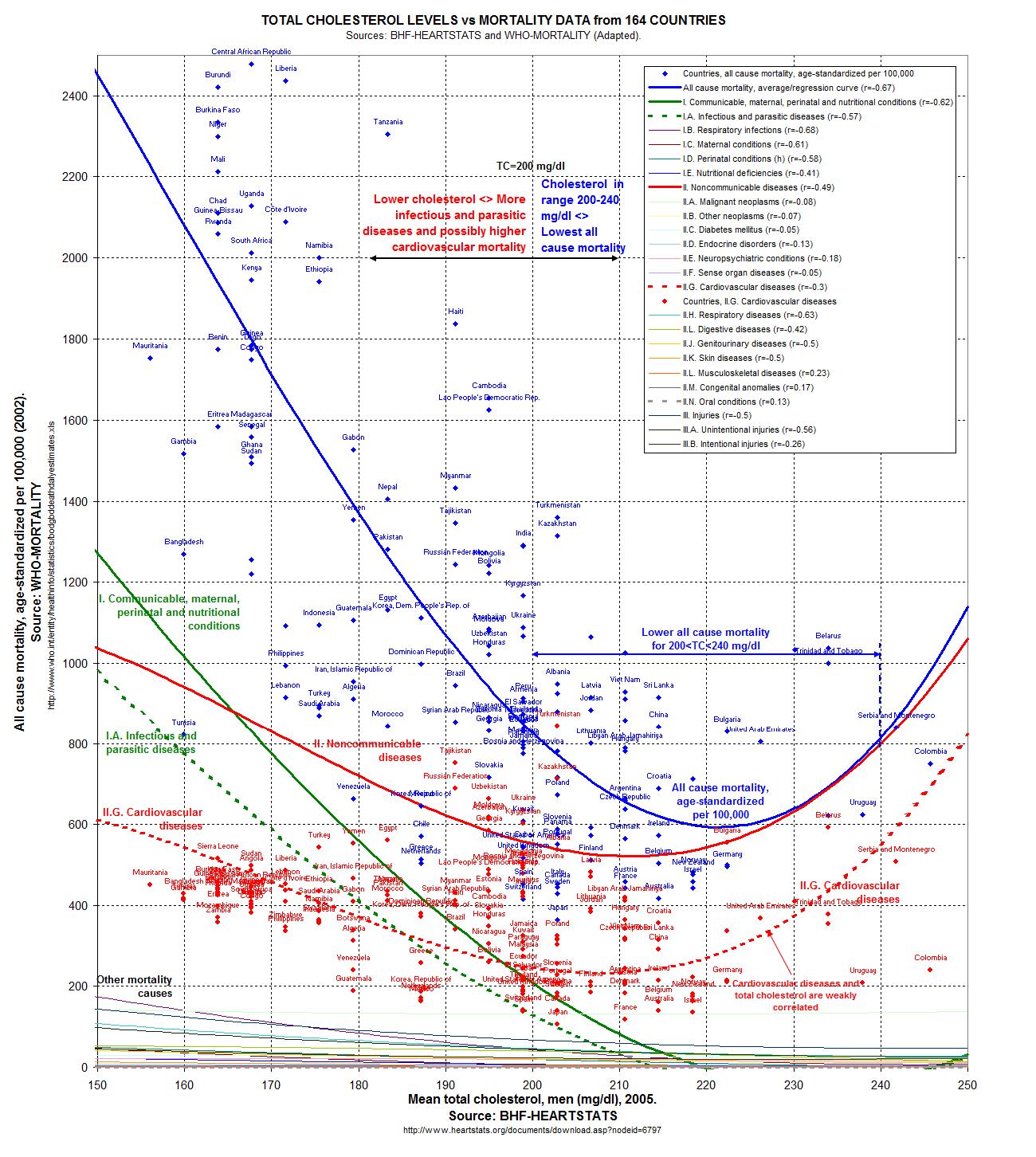
WHO: Cholesterol levels vs. all cause mortality in 164 countries.
Here is what the graph shows:
According to linked above, if cholesterol levels are below:
175mg/dl: your risk of having a heart attack doubles!
150mg/dl: your risk of having a heart attack triples!
If your cholesterol is below:
175mg/dl and your risk of dying more than doubles!
150mg/dl and your risk of dying quadruples!
The optimal cholesterol level to limit your risk of dying from cardiovascular disease is between 200-215mg/dl!
The optimal cholesterol level to limit your risk of dying from all causes is between 220-225mg/dl.
Whoa! How could this be? I thought optimal range was 100-199mg/dl?
If you follow these guidelines and your cholesterol levels are within the ranges established you are INCREASING YOUR RISK OF DYING overall.
It is also important to note that as cholesterol levels drops below 200mg/dl the incidence of heart disease as well as deaths increase rapidly.
You may be wondering who exactly makes up the NCEP panel that is responsible for setting the 100-199 range for cholesterol…
It is quite interesting to note that of the 9 so called “experts” in the field of cardiovascular disease that make up this panel fully 8 of them have financial ties to very companies that manufacture cholesterol lowering drugs!
Are you shocked? Just business as usual for those in control of America’s Health Fraud System.
These members know that the lower the recommended level of blood cholesterol the more people who fall into the “high” category. Which will mean more prescriptions and more money for Big Pharma!
If Cholesterol Isn’t The Reason For Coronary Artery Disease, What Is?
If you have been following my articles, video posts and blog posts, or if you have been or are a current patient of mine, you know that I promote the theory that Chronic Health Conditions have as their cause inflammation.
Through research as well as my clinical experience, I have found that most if not all of the chronic conditions we are facing have inflammation as the common factor between them. Coronary Heart/Artery Disease is no different.
This is not a new and novel idea, it has been suggested and proven in published research as far back as in 1911 in which a study conducted on human arteries concluded that "there is every indication that the production of tissue in the intima [tunica intima the inside surface of an artery] is the result of a direct irritation of that tissue by the presence of infection or toxins or the stimulation by the products of a primary degeneration in that layer."
- Klotz O, Manning MF. Fatty streaks in the intima of arteries. Journal of Pathology and Bacteriology. 16, 211-220, 1911.
Since that time there have been countless studies that have come to the same conclusion:
Arterial Diseases such as Atherosclerosis, CAD, Heart Disease and the like can all be traced back to inflammation.
“One such study done in 1976 categorized the cause of atherosclerosis as the Response to Injury Hypothesis. The study findings suggested that atherosclerosis is the consequence of an inflammatory process, where the first step is a localized injury to the thin layer of cells lining the inside of the arteries, the intima. The injury causes inflammatory response of the immune system. The findings of cholesterol plaque within the artery are simply healing lesions that occur to repair the intima.”
-Ross R, Glomset JA. The pathogenesis of atherosclerosis. New England Journal of Medicine 295, 369-377, 1976.
What About Studies That High Cholesterol = Risk Factor For Heart Disease?
The research is typically done with middle-aged men. This age group is usually at the peak of family life along with their professional careers. This can be highly stressful to many if not most of the subjects. High cholesterol may therefore reflect a stressed state of being. Stress is known to increase cholesterol and stress is also a well-known risk factor for heart disease!
The adrenal glands are known as our stress glands. Stressful situations increase our blood cholesterol levels because cholesterol is being sent to the adrenal glands for stress hormone production.
Also whenever we are under stress a storm of free radicals and other damaging biochemical reactions occur in the blood. So the liver works hard to produce and send out as much cholesterol as possible to deal with the free radical attack.
Therefore, high cholesterol would not be the cause of Cardiac Disease, but more appropriately used as a marker for a system under a high load of life endangering issues.
Utilizing the above referenced studies, high cholesterol in this group of middle-aged men could, for instance, reflect the body’s need for more cholesterol so that it my effectively respond to the stress put upon it by producing adequate stress hormones.
Making high cholesterol a disease condition is obviously in conflict with the idea that high cholesterol protects against infections and prolongs life!
BOTH IDEAS CANNOT BE, AT THE SAME TIME, TRUE!
A high blood cholesterol level may mean that the body is dealing with some kind of damage. After the damage has been dealt with cholesterol levels should naturally go down.
These are the very types of patients that I see in my office on a daily basis, they have an ongoing disease process in the body that continually inflicts damage; may of them have high plasma cholesterol levels as well as high triglyceride levels...If you would like to know more or have some chronic health issue that no one has been able to help you with, please contact my office by phone or check out my website and send me message through the information request portion located at http;//LifeChangingCareHouston.com/ or you may call my office directly at 281-812-8101. You deserve honest answers about your health.... Dr. Walter K. CrooksDoctor of Pastoral MedicineChiropractic Clinical Neurologist
-->
How Important Is Cholesterol?
What Is The Optimal Range For Cholesterol?
Breaking News: Government Wages War On Cholesterol!
What if you woke up tomorrow and opened your morning paper and this was the headline you read? How would you react?
Would you jump for joy thinking that we would finally live longer and healthier lives without having to worry about diseases such as Coronary Artery Disease, Heart Disease and Atherosclerosis?
Well, even if cholesterol could be somehow made illegal, it would do nothing to stop the #1 killer of the American public since 1939. In fact, death rates would likely increase at such an astronomical rate that the job of funeral director would be the highest paid profession in the entire world!
If you find yourself asking how I could ever arrive at such a conclusion as this, when everything you have been taught for the past 30 years or more has been how cholesterol is such a bad thing, especially that “nasty” LDL cholesterol, the black sheep of the cholesterol family, so terrible is LDL that is has even been labeled “Bad Cholesterol” by your doctor, the media and just about everyone that claims to be in the know regarding life, health and cholesterol.
Well, I’m here today with some very important facts, of which I am 110% positive your doctor, pastor, neighbor, favorite television personality and even you have probably never heard before.
If you have come across one or two of the following facts and continue to think of cholesterol as your enemy then the context in what you had read the information was either not engaging enough for you to follow up on or the information was vilified by the writer, regardless the reason, the fact remains that your health did not improve with the information you may have received.
So let’s see if we can improve your life today, even a small improvement in health is better that no improvement! You will find here written information that will help immediately, to assist and improve your chances at a longer and healthier tomorrow…
I would be lying if I were to claim, as my own, the following information packed list of cholesterol facts. In fact, what I have done here in assembling these different studies and their conclusions is really the easy part, what must be very difficult for many of these researchers is the fact that, in order to tell the honest truth with unbiased research, many research scientists have put their careers on the line.
Think of the billions of dollars the makers of the drugs such as Lipotor®, Mevacor®, Zocor® and Crestor® would be at risk of losing if people would find out the truth about how great cholesterol is and how truly terrible these statins are to their health
Time For Those Promised Cholesterol Health Facts…
Every human cell produces cholesterol for our entire lives! We need from 1000 mg/day up, depending on what the body is dealing with.
We produce around 85% of the cholesterol needed on a daily basis, 15% is derived from the food we eat.
Of the daily cholesterol produced within the body, the liver accounts for between 800-1500 mg/day, which is 60% - 70% of the body’s cholesterol, while the intestines produce approximately 15% and the individual cells of the body produce the rest of the needed cholesterol on a daily basis.
The regulation of cholesterol synthesis is an elegant process that is tightly controlled, if you eat more cholesterol you produce less, if you eat less cholesterol you produce more. If we are unable to consume the needed cholesterol from our diets we will crank up production to 100% of the cholesterol that is needed at any given moment.
“Dietary Intake Of Cholesterol Has No Effect On Plasma Cholesterol Levels”
-Br Med J (Clin Res Ed). 1987 February 7; 294(6568): 333–336. PMCID: PMC1245349; Effect of dietary cholesterol on plasma cholesterol concentration in subjects following reduced fat, high fibre diet.
- Cholesterol in our skin is converted to vitamin D3 by sunlight.
- We need cholesterol to make sex hormones.
- The insulation of a nerve, known as Myelin, is 20% cholesterol!
- Roughly 25% of the total cholesterol found within the human body is located within the brain!
Cholesterol and Fetal/Infant Development
Cholesterol is required for fetal and infant brain and eye development. Children that get inadequate cholesterol in infancy may end up with poor eyesight and brain function.
“The fetal brain and eyes require large amounts of cholesterol for development, if there is not enough cholesterol during development a congenital abnormality called cyclopean eye may result.”
-Science 1998 Jun 5;280(5369):1528-9. One-eyed animals implicate cholesterol in development.
Breast milk supplies high amounts of cholesterol to children, amazingly enough, breast milk also provides a specific enzyme to allow the baby’s digestive tract to absorb almost 100 percent of that cholesterol!
In the genetic condition, Smith-Lemli-Opitz Syndrome children are usually still born or die soon after birth. This is due to a defect in cholesterol production resulting in extremely low cholesterol levels. If the child lives they have frequent and severe infections. “However, if their diet is supplemented with pure cholesterol, their cholesterol levels increase and their bouts of infection become less serious and less frequent!”
- Elias ER et al. Clinical effects of cholesterol supplementation in six patients with the Smith-Lemli-Opitz syndrome (SLOS). American Journal of Medical Genetics 68, 305–310, 1997.
Every structure within the brain demands adequate cholesterol!
The formation and health of our brain’s synaptic connections is entirely dependent on cholesterol, in the form of apolipoprotein E, if no apolipoprotein E is available then no synaptic formation, which could lead to dementia, motor disease, insanity, you can name any nervous system disorder because they are all possible if the brain can not form new synaptic connections and maintain those already formed!
Cholesterol Used Within Tissue and Cells
Structures that are exposed to high pressure and excessive tensile forces must have reinforcement to their structures; cholesterol is what is responsible for this action.
An example are the body’s scars, these have high levels of cholesterol within them to maintain integrity of the repair.
Arterial walls need extra support in places where they converge, bend and bifurcate. These areas have very high amounts of cholesterol within the wall’s structure, giving them what is known as a “fatty streak” appearance. This is a natural and indispensable function of cholesterol, without this support the arteries would burst from the pressure flow at these points!
Doctor’s have been known to prescribe Cholesterol Lowering Medications due to ignorance of human blood vessel physiology & anatomy.
FATTY STREAKS ARE NOT THE EARLY STAGES OF ATHLERCLEROSIS!
Bile produced by our liver and stored in our gallbladder is made from cholesterol. Bile is required in the digestion and absorption of dietary fats in the diet along with fat soluble vitamins such as Vitamins D, A and E!
Type 2 Diabetes and Cholesterol Lowering Statin Drugs.
“A research study based on 161,808 postmenopausal women aged 50 to 79 years at 40 clinical centers across the United States conducted by researchers from the University of Massachusetts Medical School and Harvard Medical School, found that women take statins, as prescribed, have a whopping 71% increased risk of developing Type 2 Diabetes!” - Arch Intern Med. 2012 Jan 23;172(2):144-52. Epub 2012 Jan 9. Statin use and risk of diabetes mellitus in postmenopausal women in the Women's Health Initiative.
-->
“A similar study on Lipitor reported in Business Week Magazine (Jan. 28, 2008) found that the drug’s efficacy was one percent.”
In other words, 100 people needed to take the drug in order for one person to live longer.
- Ravnskov U. High cholesterol may protect against infections and atherosclerosis.
Quarterly Journal of Medicine 96, 927-934, 2003.
Immune Function, Cholesterol and Triglycerides
The false notion that LDL cholesterol is bad and HDL cholesterol is the good guy has been shown false by many research studies including these below.
LDL transports cholesterol from your liver to the various places in your body where cholesterol is needed, such as your cells. HDL transports cholesterol back to your liver to be re-used. Your body is dependent on LDL and cholesterol for hormone production.
Hormones such as: Testosterone, Progesterone, Pregnenolone, Androsterone, Estrone, Estradiol, Corticosterone, Aldosterone and more are produced from cholesterol which is transported by LDL….
Without LDL (the so-called ‘bad’ cholesterol) your body would not be capable of making these steroid hormones!
LDL Is Instrumental In Immune System Activity.
Sepsis, a life-threatening blood infection caused by bacteria in the blood, is associated with a high level of triglycerides. “A study done on animals with sepsis that were injected with solutions rich in triglycerides found that the triglycerides were able to protect the animals from the toxic effects of the endotoxin and they concluded that the high level of triglycerides seen in sepsis is a normal immune response to infection.”
-Harris HW, Gosnell JE, Kumwenda ZL. The lipemia of sepsis: triglyceride-rich lipoproteins as agents of innate immunity. Journal of Endotoxin Research 6, 421-430, 2001.
White blood cells are a part of our immune system. Adequate concentrations are needed to fight off foreign invaders such as the flu virus. In a study using healthy young and middle-aged men it was found that the “total number of white blood cells and the numbers among the various types of those white blood cells were significantly lower in the men with LDL-cholesterol below 160 mg/dl” than in men with higher LDL-cholesterol levels.
Low LDL Levels Cause Pathological Immune System Disruption!
-Muldoon MF and others. Immune system differences in men with hypo- or hypercholesterolemia. Clinical Immunology and Immunopathology 84, 145-149, 1997.
Staphylococcus aureus is the bacteria that causes MRSA (Methicillin- resistant Staph aureus), a severe and life threatening infection. The toxin produced can literally dissolve red blood cells on contact!
“In this study it was found that in the presence of adequate plasma concentrations of LDL-cholesterol that same toxin is RENDERED 90% INEFFECTIVE!”
(HDL and other plasma constituents were ineffective against the toxin.)
-Bhakdi S and others. Binding and partial inactivation of Staphylococcus aureus a-toxin by human plasma low density lipoprotein. Journal of Biological Chemistry 258, 5899-5904, 1983.
In a study done on mice, purified bacterial endotoxin (toxic poison) was injected into normal mice as well as into mice with familial hypercholesterolemia (FM), a genetic disorder that causes continuous severely high cholesterol, these FM mice had LDL-cholesterol four times (4X’s) higher than normal mice.
“All of the normal mice died from the toxin as expected, but in order to kill the mice with the Familial Hypercholesterolemia it was necessary to inject those mice with EIGHT TIMES MORE ENDOTOXIN than was necessary to kill the normal cholesterol mice!”
-Netea MG and others. Low-density lipoprotein receptor-deficient mice are protected against lethal endotoxemia and severe gram-negative infections. Journal of Clinical Investigation 97, 1366-1372, 1996.
A mechanism in which endotoxins affect white blood cells is through stimulating WBC to produce certain cytokines. Using “LDL cholesterol from these patients had an inhibitory effect on these serum cytokines.”
-Weinstock CW and others. Low density lipoproteins inhibit endotoxin activation of monocytes. Arteriosclerosis and Thrombosis 12, 341-347, 1992.
Cholesterol And AIDS
“Men with the lowest cholesterol, below 160 mg/dL, had a three-fold increased risk of DEATH from AIDS compared to men who had cholesterol levels above 240 mg/dL!”
(The study included 332,547 men aged between 35-57 who were followed for 16 years.)-AIDS. 1997 Jun;11(7):929-30. Low serum cholesterol and risk of death from AIDS.
“Men with low cholesterol (less than 160 mg/dl) had a 66% increase in HIV infection compared to men with higher cholesterol levels.”
-Published in the J Acquir Immune Defic Syndr Hum Retrovirol. 1998 Jan 1;17(1):51-7.
Cholesterol And Mental Health
“Low serum cholesterol levels have a very strong association with criminal violence!”
-J Psychiatr Res. 2000 Jul-Oct;34(4-5):301-9. Low cholesterol and violent crime.
“Low cholesterol levels are also strongly associated with suicidal tendencies.”
-Psychiatry Res. 2010 Jun 30;178(1):217-9. Epub 2010 May 8; Cholesterol, CSF 5-HIAA, violence and intent in suicidal men.
Oxford professor David Horrobin, M.D. (RIP) was a leading Researcher of Fatty Acids has stated: "reducing cholesterol on a large scale could lead to a general shift to more violent patterns of behaviour. Most of this increase in violence would not result in death but in more aggression at work and in the family, more child abuse, more wife-beating and generally more unhappiness."
-Horrobin David F. Lowering cholesterol concentrations and mortality. British Medical Journal 301, 554, 1990.
High Cholesterol Increases Chronic Illness Survival Rates!
“Having high cholesterol leads to higher survival rates![]() in people with chronic kidney disease, chronic heart failure, chronic obstructive lung disease, cancer, AIDS, rheumatoid arthritis, and in the elderly.”
-Current Opinion in Clinical Nutrition & Metabolic Care 2007 Jul;10(4):433-42
“Low cholesterol levels predicted an increased risk of dying from gastrointestinal and respiratory diseases.”
-Jacobs D and others. -Report of the conference on low blood cholesterol: Mortality associations. Circulation 86, 1046–1060, 1992.
The Massachusetts Institute of Technology did a search of the medical literature and found no studies that have ever proved that statin drugs improve all-cause mortality rates. Statins do lower cholesterol, but this alone did not prolong life. “In fact, MIT found that statins actually contribute to the deterioration of the quality of life by destroying muscles, damaging the liver, harming the kidneys and even endangering heart function, which can lead to heart disease and death.”
Krumholz HM and others. Lack of association between cholesterol and coronary heart disease mortality and morbidity and all-cause mortality in persons older than 70 years. Journal of the American Medical Association. 272, 1335-1340, 1990.
“The risk of dying from chronic heart failure was strongly and inversely related to total cholesterol levels, LDL-cholesterol and triglycerides. Patients with the highest serum levels lived much longer than those with lower levels.”
-Rauchhaus M and others. The relationship between cholesterol and survival in patients with chronic heart failure. Journal of the American College of Cardiology 42, 1933-1940, 2003.
“The Department of Cardiovascular Medicine at Yale University reported that old people with low cholesterol died twice as often from a heart attack as did people with high cholesterol.”
Jacobs D and others. Report of the conference on low blood cholesterol: Mortality associations. Circulation 86, 1046-1060, 1992.
“A study consisting of more than a thousand patients with severe heart failure showed that of those with cholesterol levels below 129 mg/l over 75% had died within 5 years, whereas the survival rate for the same time period was more than 50% among those patients who had the highest cholesterol upwards of 223 mg/dl!”
- Horwich TB and others. Low serum total cholesterol is associated with marked increase in mortality in advanced heart failure. Journal of Cardiac Failure 8, 216-224, 2002.
“The MRFIT study (Multiple Risk Factor Intervention Trial) studied 180,000 men over a 13-year period and found that men with cholesterol of 330 had less hemorrhagic stroke than men with cholesterol levels less than 180.”
HIGH CHOLESTEROL PREVENTED STOKES!
-Ottobomi F, Ottobomi A. J Orthomaol Med 2005;20:179-83. Ravnskov U. High cholesterol may protect against infections and atherosclerosis. Quarterly Journal of Medicine 96, 927-934, 2003
“our cells, immune, endothelial, nerve and most other cells, are comprised mostly of cholesterol, logically if injured they require huge amounts of cholesterol in order to be repaired"
"Cholesterol is anti-inflammatory as well as an antioxidant.”
-Curr Eye Res. 1999 Jun;18(6):448-54. Cholesterol may act as an antioxidant in lens membranes. Girao H, Mota C, Pereira P
“Immediately after myocardial infarction there is a very significant up regulation in cholesterol production for repair of heart tissues.”
-Pfohl M and others. Upregulation of cholesterol synthesis after acute myocardial infarction--is cholesterol a positive acute phase reactant? Atherosclerosis. 1999 Feb;142(2):389-93.
WHO: Cholesterol levels vs. all cause mortality in 164 countries.
Here is what the graph shows:
According to linked above, if cholesterol levels are below:
175mg/dl: your risk of having a heart attack doubles!
150mg/dl: your risk of having a heart attack triples!
If your cholesterol is below:
175mg/dl and your risk of dying more than doubles!
150mg/dl and your risk of dying quadruples!
The optimal cholesterol level to limit your risk of dying from cardiovascular disease is between 200-215mg/dl!
The optimal cholesterol level to limit your risk of dying from all causes is between 220-225mg/dl.
Whoa! How could this be? I thought optimal range was 100-199mg/dl?
If you follow these guidelines and your cholesterol levels are within the ranges established you are INCREASING YOUR RISK OF DYING overall.
It is also important to note that as cholesterol levels drops below 200mg/dl the incidence of heart disease as well as deaths increase rapidly.
You may be wondering who exactly makes up the NCEP panel that is responsible for setting the 100-199 range for cholesterol…
It is quite interesting to note that of the 9 so called “experts” in the field of cardiovascular disease that make up this panel fully 8 of them have financial ties to very companies that manufacture cholesterol lowering drugs!
Are you shocked? Just business as usual for those in control of America’s Health Fraud System.
These members know that the lower the recommended level of blood cholesterol the more people who fall into the “high” category. Which will mean more prescriptions and more money for Big Pharma!
If Cholesterol Isn’t The Reason For Coronary Artery Disease, What Is?
If you have been following my articles, video posts and blog posts, or if you have been or are a current patient of mine, you know that I promote the theory that Chronic Health Conditions have as their cause inflammation.
Through research as well as my clinical experience, I have found that most if not all of the chronic conditions we are facing have inflammation as the common factor between them. Coronary Heart/Artery Disease is no different.
This is not a new and novel idea, it has been suggested and proven in published research as far back as in 1911 in which a study conducted on human arteries concluded that "there is every indication that the production of tissue in the intima [tunica intima the inside surface of an artery] is the result of a direct irritation of that tissue by the presence of infection or toxins or the stimulation by the products of a primary degeneration in that layer."
- Klotz O, Manning MF. Fatty streaks in the intima of arteries. Journal of Pathology and Bacteriology. 16, 211-220, 1911.
Since that time there have been countless studies that have come to the same conclusion:
Arterial Diseases such as Atherosclerosis, CAD, Heart Disease and the like can all be traced back to inflammation.
“One such study done in 1976 categorized the cause of atherosclerosis as the Response to Injury Hypothesis. The study findings suggested that atherosclerosis is the consequence of an inflammatory process, where the first step is a localized injury to the thin layer of cells lining the inside of the arteries, the intima. The injury causes inflammatory response of the immune system. The findings of cholesterol plaque within the artery are simply healing lesions that occur to repair the intima.”
-Ross R, Glomset JA. The pathogenesis of atherosclerosis. New England Journal of Medicine 295, 369-377, 1976.
What About Studies That High Cholesterol = Risk Factor For Heart Disease?
The research is typically done with middle-aged men. This age group is usually at the peak of family life along with their professional careers. This can be highly stressful to many if not most of the subjects. High cholesterol may therefore reflect a stressed state of being. Stress is known to increase cholesterol and stress is also a well-known risk factor for heart disease!
The adrenal glands are known as our stress glands. Stressful situations increase our blood cholesterol levels because cholesterol is being sent to the adrenal glands for stress hormone production.
Also whenever we are under stress a storm of free radicals and other damaging biochemical reactions occur in the blood. So the liver works hard to produce and send out as much cholesterol as possible to deal with the free radical attack.
Therefore, high cholesterol would not be the cause of Cardiac Disease, but more appropriately used as a marker for a system under a high load of life endangering issues.
Utilizing the above referenced studies, high cholesterol in this group of middle-aged men could, for instance, reflect the body’s need for more cholesterol so that it my effectively respond to the stress put upon it by producing adequate stress hormones.
Making high cholesterol a disease condition is obviously in conflict with the idea that high cholesterol protects against infections and prolongs life!
BOTH IDEAS CANNOT BE, AT THE SAME TIME, TRUE!
A high blood cholesterol level may mean that the body is dealing with some kind of damage. After the damage has been dealt with cholesterol levels should naturally go down.
These are the very types of patients that I see in my office on a daily basis, they have an ongoing disease process in the body that continually inflicts damage; may of them have high plasma cholesterol levels as well as high triglyceride levels...If you would like to know more or have some chronic health issue that no one has been able to help you with, please contact my office by phone or check out my website and send me message through the information request portion located at http;//LifeChangingCareHouston.com/ or you may call my office directly at 281-812-8101. You deserve honest answers about your health.... Dr. Walter K. CrooksDoctor of Pastoral MedicineChiropractic Clinical Neurologist
 Recently, the Tri-County Diabetes Partnership declared the rate of diabetes in Floyd, Johnson and Magoffin counties (map) "a crisis of epidemic proportions." The rate in 2002-10, the latest available, was 14 percent.